
Best Of
Re: Coffee
I had a funky cup of Burundi this morning. My guess is that, being neighbors, the potato defect doesn't have much regard for boundaries. I haven't noticed this yet, with ~100lbs roasted. I'll know more after I brew more from this last roast and check my roasting notes to make sure I didn't pooch the roast.
 peter4jc
Re: you can't make this stuff up
It’s not just younger generations, and I completely disagree with it affecting minorities or low income people more. AI is the cause of so many “white collar” workers losing jobs. They’ve been relying on it for a few years now and with companies realizing the cost effectiveness of using a computer to cut out the middle man people are being left out.
As far as students, I just find it hard to believe that it affects minorities or low income more in that aspect either. Why would it? White kids aren’t looking to improve their grades? Rich kids don’t want an easier way to make better grades?
Fact of the matter is, we have a generation coming up that was raised by the internet as a babysitter and younger parents that have been taught by the internet that it’s better to be a child’s friend than their parent. Critical thinking is too hard for these generations because the internet has taught them they should be able to do everything the easy way. To let someone else think for them. It doesn’t have anything to do with race or income. It has to do with the societal loss of morality.
 Rdp77
Re: CCom Fitness Thread
I hate to say but I think my running days are over. After trips to the doctors and shots in my knees over the years, I think it’s time to find something else. Body weight exercises and weights are a staple for me but I need some cardio. I have been walking every day but just not the same.

Re: you can't make this stuff up
If in the next decade or two you notice that everyone around you is significantly less intelligent and even worse at critical thinking than they are today, you can blame AI. Because if you give an entire generation of kids the ability to magically do their homework at the push of a button, they’re going to smash it to bits.
New research from the Pew Research Center found that AI has created a fundamental shift in how younger generations are processing information, and it’s mostly that they aren’t processing it at all and are leaving it up to an AI chatbot.
According to the survey of teens aged 13 to 17, a deeply concerning 54 percent now admit to using AI for “homework help,” a nebulous term that ranges from legitimate tutoring to just blatantly using it to do their assignments for them. Only 45 percent of students claim to be staying away from AI entirely. The biggest group to keep our eyes on, and probably the ones that will be ruining our collective lives in the future, are the 10 percent of respondents who report using AI for “all or most” of their assignments.
AI Is Hitting Low-Income Gen Alpha Students the Hardest
The study found that minority and low-income students are significantly more likely to lean on these tools for school work. Specifically, 20 percent of students in households earning less than $30,000 a year use AI for all or most of their work, compared to just seven percent of kids in households making over $75,000 a year. Race plays a big factor. Black and Hispanic teens are 12 percent more likely than their white peers to outsource a majority of their school work to a chatbot.
While the AI is probably making the kids look smarter than they actually are, and thus possibly getting better grades than they normally would, that’s the problem. There is very likely going to be a significant proportion of younger people who slip through the US educational system, graduate high school, breeze through college, and make it out into the real world without having developed any of the skills necessary to survive because they offloaded all the trials and tribulations that forge actual, practically applicable intelligence.
With little to no regulations on the way, things are looking grim for the future of American critical thinking skills.

Re: Coffee
@silvermouse said:
Good plan. Thanks Chris. I was concerned because the article I linked to suggested that a few beans could taint the whole bag.
That's definitely not my experience, I've had this happen to me a few times and it only affects the brew with the defect bean in it, not the whole bag. It put me off buying greens from Rwanda / Burundi / Uganda for a while but the situation seems to have improved a bit and those coffee origins are so tasty so I've resumed buying from those regions in recent years.
 Yakster
Re: Post Every Boring Aspect Of Your Mundane Life Thread
On my walk today, I went 6 for 6; every car I waved at waved back at me.
So let's say 2 of those 6 waves at 6 people tomorrow, and they get 2 people to wave back, the next day there'd be 4 people waving at 6. And if 2 of that group waves back the next day, there'd be 12. Before you know it, you're going to get waved at, and it'll all be because of me.
peter4jc
Re: What are you reading?
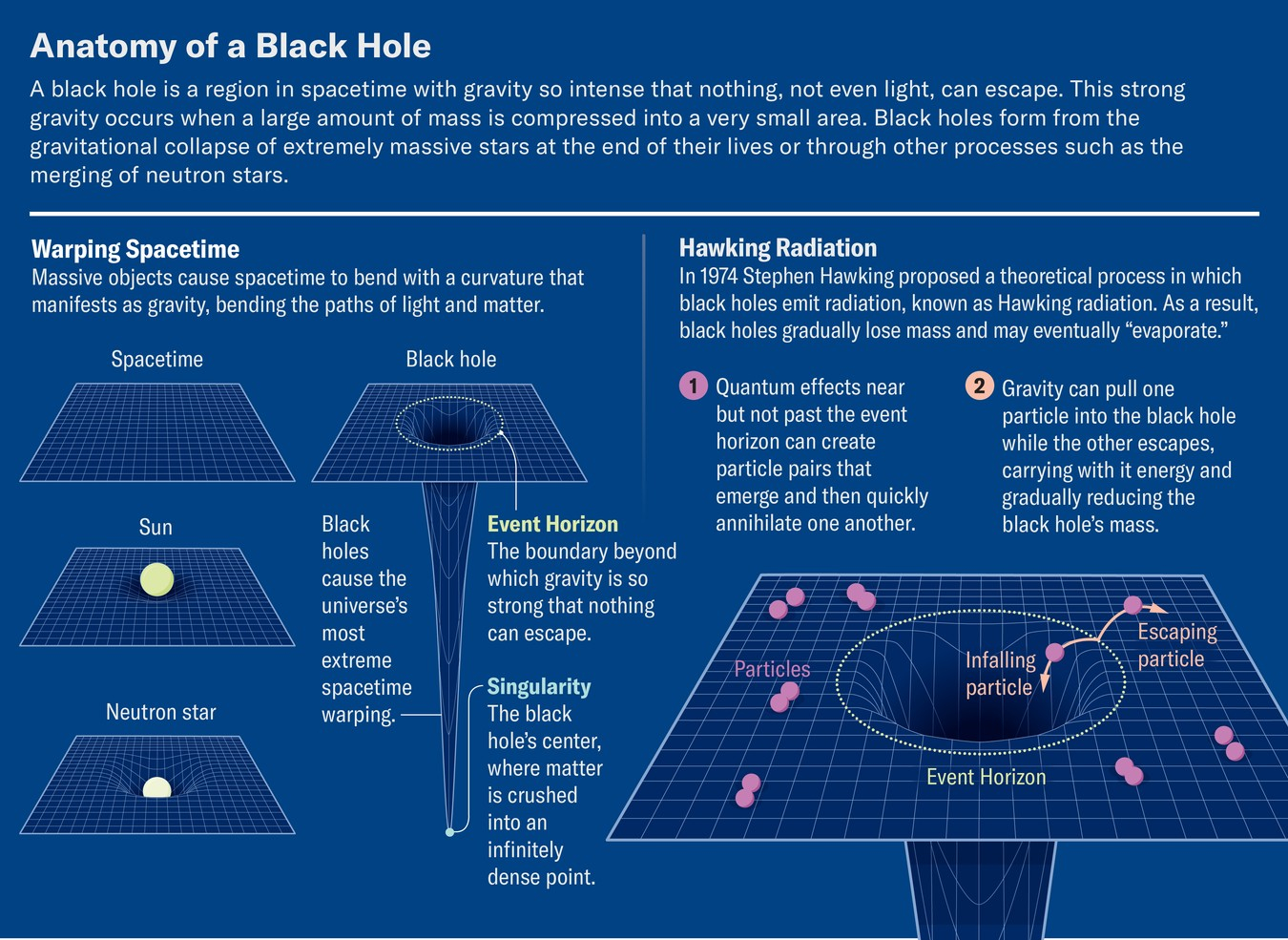
Like physics, math has its own set of “fundamental particles”—the prime numbers, which can’t be broken down into smaller natural numbers. They can only be divided by themselves and 1.
And in a new development, it turns out these mathematical “particles” are offering new ways to tackle some of physics’ deepest mysteries. Over the past year, researchers have found that formulas based on the prime numbers can describe features of black holes. Number theorists have spent hundreds of years deriving theorems and conjectures based on the primes. These new connections suggest that the mathematical truths that govern prime numbers may also govern some fundamental laws of the universe. So can physics be expressed in terms of primes?
More here:
https://www.scientificamerican.com/article/are-prime-numbers-hiding-inside-black-holes/